An interactive first chapter
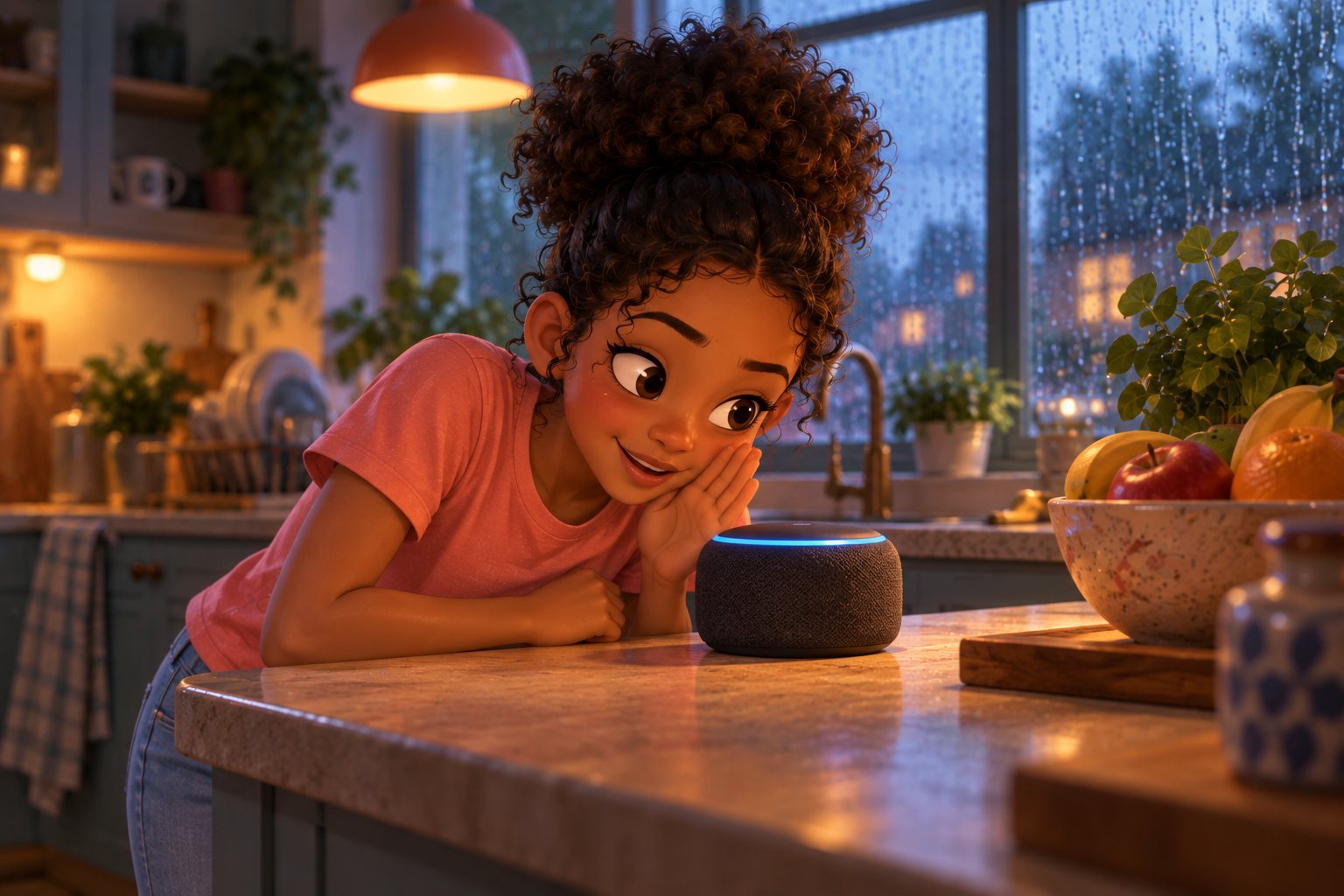
Nia leaning on the kitchen counter on a rainy afternoon, whispering to a small smart speaker beside the fruit bowl.

The Day You Talked to a Machine

Chapter One

It was raining, which meant Nia was bored, which meant trouble.

She wandered into the kitchen, where the little round speaker sat on the counter next to the fruit bowl. Nia leaned close to it, the way you might lean close to a friend to tell a secret.

“Play something cool,” she said.

The speaker lit up in a ring of blue.

Right now it’s eleven degrees and cloudy, with rain continuing into the evening.

Nia stared at it. “No. Cool. Like, cool cool. Music.”

Here’s a playlist called Chill Winter Vibes.

Soft piano music floated out, it sounded exactly like the same song she had heard while sitting in the dentist’s waiting room last week. Nia groaned and flopped onto a kitchen chair.

Her little brother Nathan poked his head round the door. He was seven, and last week he had watched half of a movie about robots that take over a city, which was exactly half a movie too much.

“Is it listening to us?” he whispered.

“It’s a speaker, Nate.”

“But it answered. How does it know what you said?”

Nia opened her mouth to explain, and then closed it again. She didn’t actually know.

To cover this up, she picked up Mum’s phone to text Gran. Love you Gran, see you Sunday, she typed, and hit send without looking.

A minute later the phone buzzed.

Thank you, darling. It’s an old family recipe.

Nia scrolled up. Her message now read: Love your gravy, see you Sunday.

See it happen: tap Send

Gran ›
Today 4:12 PM
Love you Gran, see you Sunday

Nathan laughed so hard he had to sit on the floor.
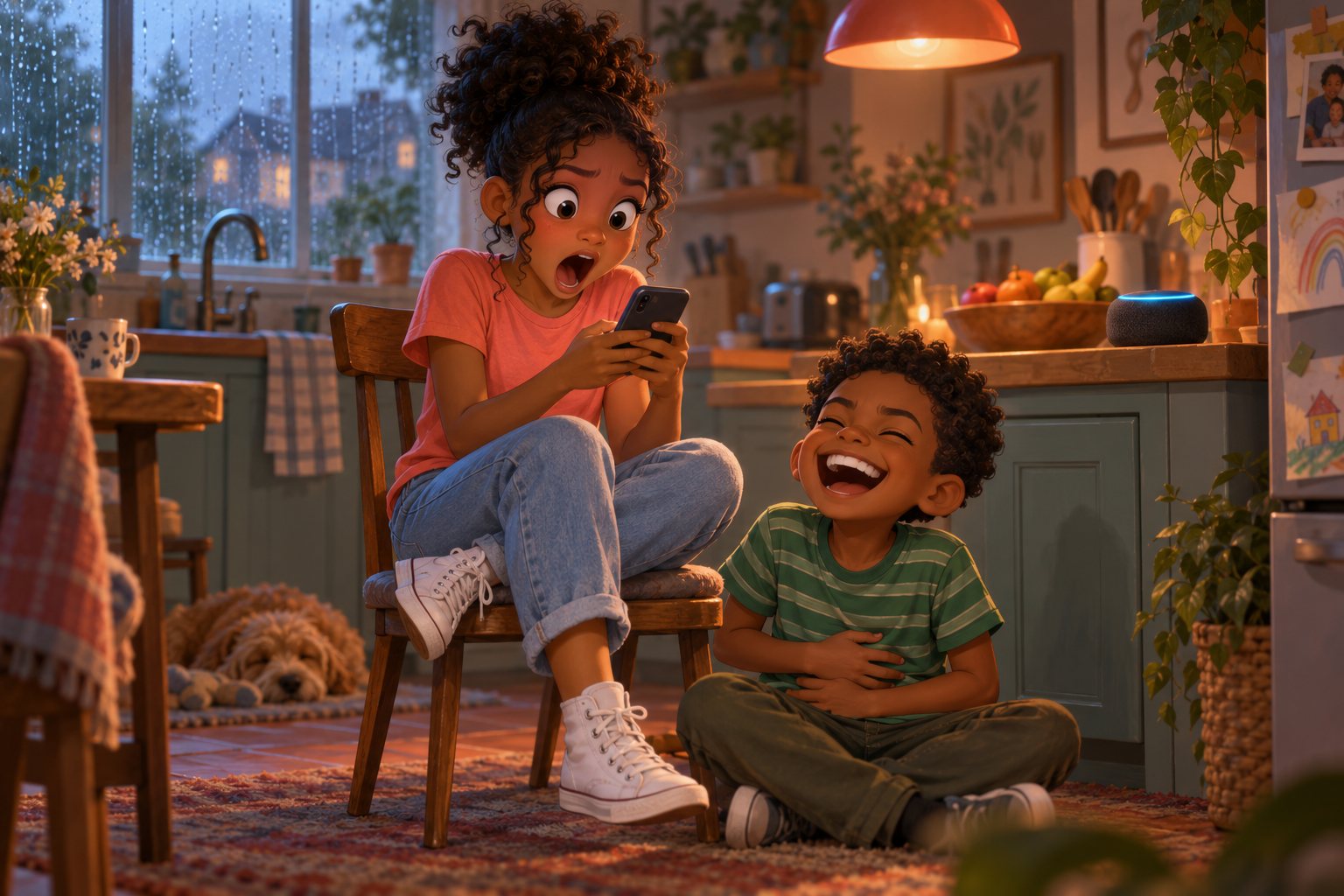
Nia on a kitchen chair staring at the phone in horror while her little brother Sam laughs on the floor.

Later, when the kitchen was empty and the rain was still going, Nia looked at the speaker for a long time.

“Thanks for the music,” she said, a bit awkwardly. Then, more quietly: “Do you get lonely at night? When we’re all asleep?”

The blue ring lit up.

Sorry, I didn’t catch that.

Nia wasn’t sure whether that made her feel better or worse.

Maybe you’ve had a day like Nia’s.

You asked a machine a question, and it answered. Maybe it got it right: it told you how tall a giraffe is, or counted down ten minutes for your pizza. Maybe it got it hilariously wrong. Either way, you probably didn’t think much about it. Most of us don’t. We’ve gotten used to talking to machines, and machines talking back.

But that’s strange, isn’t it? When you really think about it?

For thousands and thousands of years, if you wanted to ask something a question, you asked another person. You went to your mother, your teacher, a wise elder, a librarian, a friend. They answered, or they didn’t, or they shrugged and said, “I don’t know, let’s find out together.” Conversation was something humans did with each other.

But now, we've started talking to things. Things that aren’t alive. Things without faces. And they started talking back.

Can you confuse the speaker?

Nia did it by accident. Try it on purpose.

Tap something to say to the kitchen speaker and see what happens.

It isn’t just speakers on kitchen counters.

When you open a video app and the very first video looks exactly like something you’d want to watch, that’s a machine making a guess about you.

When you take a photo and your camera draws a little square around your friend’s face, that’s a machine recognizing a face.

When you type a message and the keyboard finishes your sentence for you (sometimes with gravy), that’s a machine guessing what you meant to say.

When your family’s maps app says there’s traffic ahead and suggests a different route, that’s a machine looking at thousands of other people’s phones and figuring out the road is jammed before you get there.

You are surrounded, every single day, by machines that watch, listen, guess, learn, and answer. Most of them have no body. They live inside other things: your phone, your TV, the car your family drives, the websites you visit. They are quiet, invisible, and almost everywhere.

What we call all of this, today, is artificial intelligence, usually shortened to AI.

We’re going to spend this whole book figuring out what AI actually is and what it isn’t.

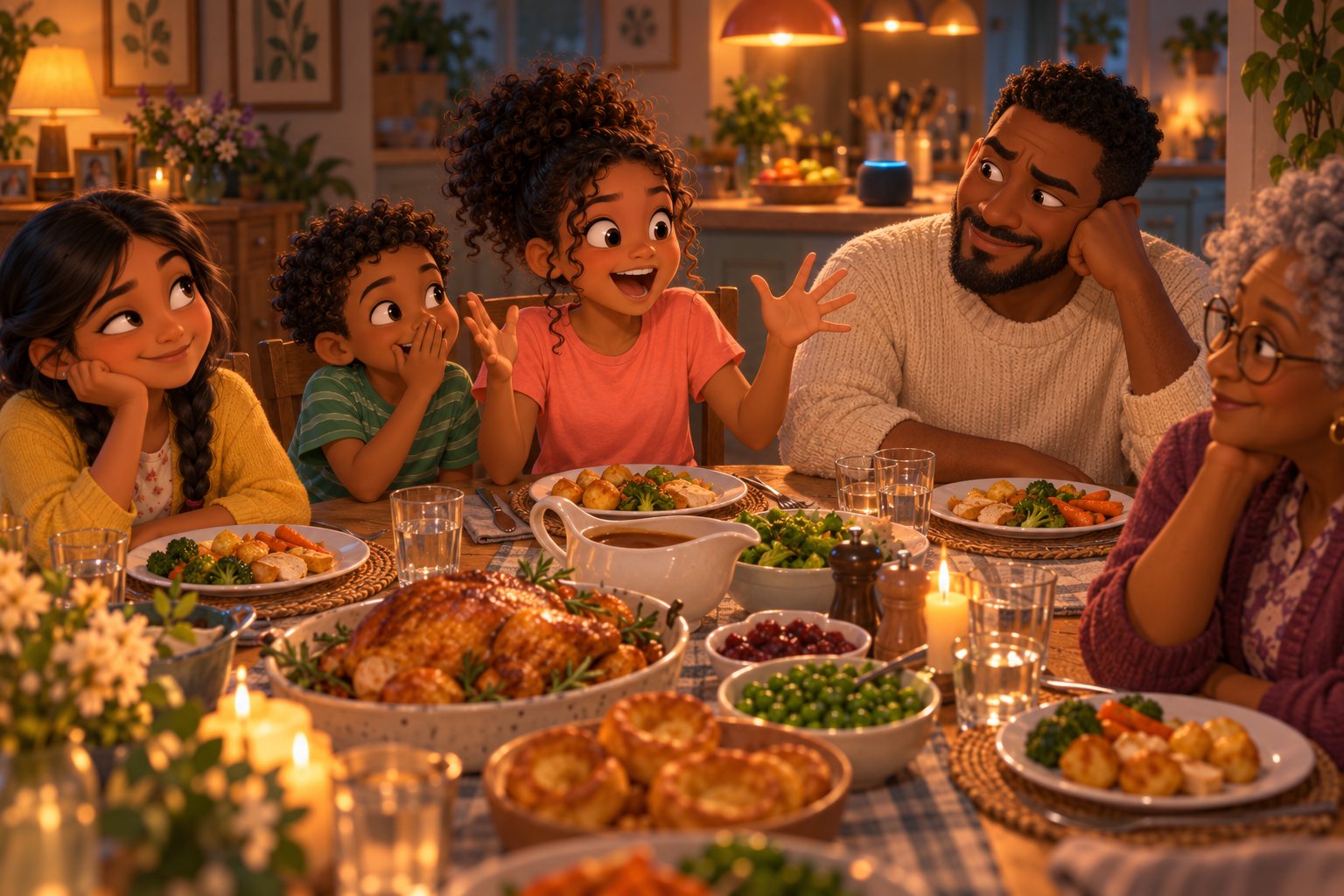
Nia telling the story at Sunday dinner while Priya rolls her eyes, Sam whispers, Dad looks puzzled and Gran smiles, with a gravy boat in the middle of the table.

At Sunday dinner (with gravy), Nia told everyone about the speaker and the text. She expected them to laugh. Instead, everyone had something different to say.

Her dad shook his head. “I don’t really understand any of that stuff,” he said. “It’s not for me.”

Nathan said, very seriously, that the speaker was probably a spy.

Nia’s best friend Samantha, who had come for dinner, rolled her eyes. “It’s not a spy. It’s just really, really smart. It knows basically everything. I ask it all my homework questions.”

Nia mostly thought it was fun. Something to poke at when it was raining and she was bored.

Tap each person at the table

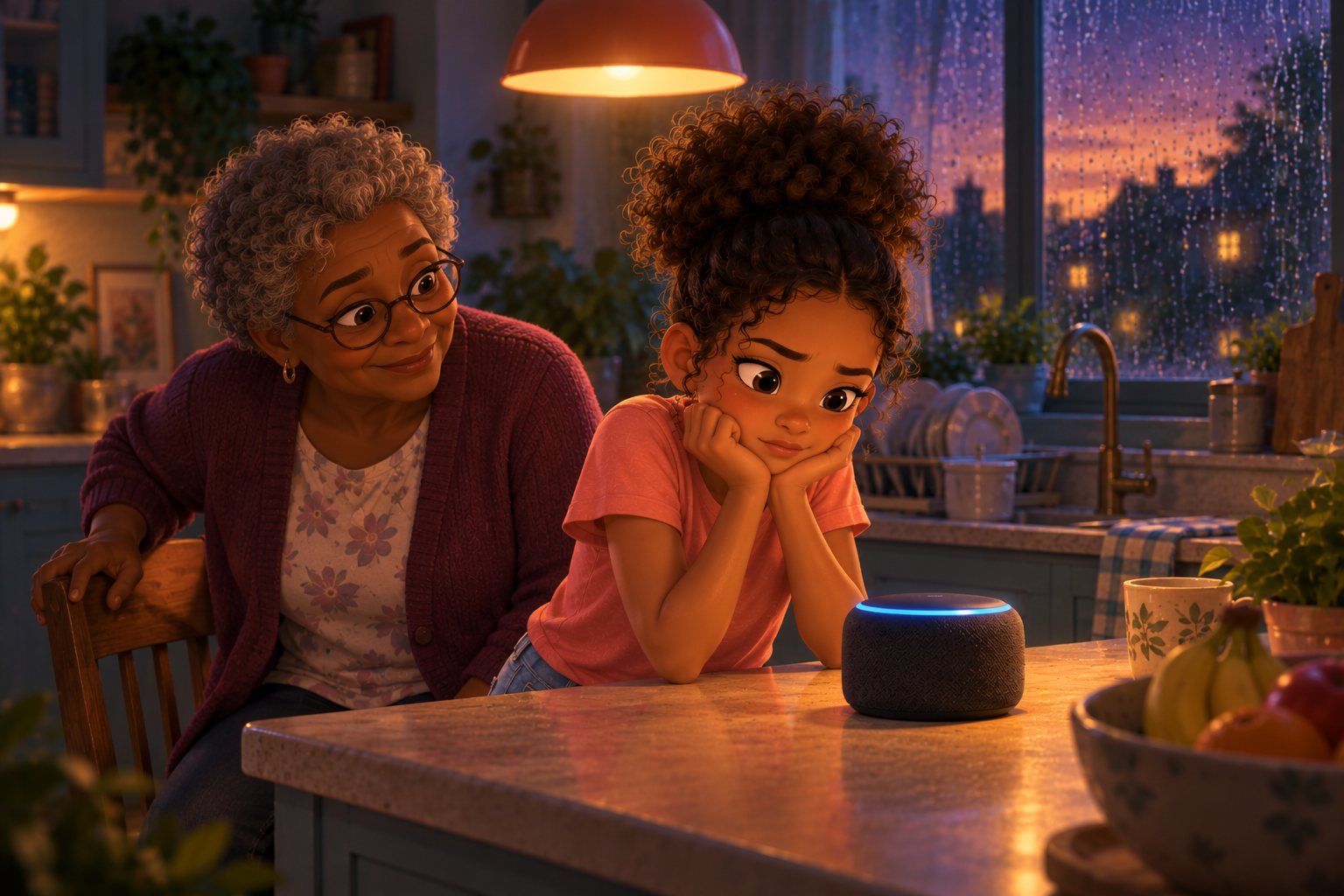
Gran sitting down beside Nia in the evening kitchen as Nia frowns thoughtfully at the smart speaker.

After dinner, Gran found Nia by the kitchen counter, frowning at the speaker again.

“Still trying to figure it out?” Gran asked.

“I asked it if it gets lonely,” Nia admitted. “It didn’t understand me. And I don’t understand it. Nobody does. Dad doesn’t, Nate thinks it’s a spy, and Sam thinks it knows everything.”

Gran pulled out a chair and sat down, slowly, the way she did everything.

“I don’t understand it either,” Gran said. “But I don’t think it’s magic. People made it, so I'm sure you can also learn about it. From what I’ve heard, even the clever people who built it still don't understand some parts of it.”

She smiled. “Sounds like there’s plenty left to discover. And not understanding something is a very good place to start!.”

The first thing this book asks of you is one of the oldest things any teacher has ever asked of any student.

Be curious.

Look at the strange thing in front of you, ask what it really is, and don’t stop at the first answer you’re given.

Long before there were any screens, any phones, or even electricity, Aristotle noticed something true about us: we want to understand things. We want to look behind the curtain. Babies have that desire. Scientists have it. The greatest inventors, explorers, and builders all had it. So, probably, do you.

The book of Proverbs also says that some things in the world are hidden on purpose, and discovering them is what kings are honored for. So every time you dig, ask, or try to learn how something works, you’re doing something royal. Kings and queens, princes and princesses all do this - and so do you!.

The world is full of hidden things, and you were made to seek them out.

This includes AI.

Try this: the AI Hunt

Tomorrow, from the moment you wake up until lunchtime, keep a piece of paper in your pocket. Every time you notice a machine guessing, recognizing, recommending, or answering, make a tally mark and write down what it was.

Look out for: video suggestions, autocorrect, maps, voice assistants, photo apps, even the “you might also like” section of a website.

No paper handy? Tap a box instead. Your tally is saved on this device.

You’ve spotted 0 so far.

    How many did you find? Were you surprised? Did any of them get it wrong?

    Here is the plan for the rest of this book.

    We are going to look at AI honestly. We’ll figure out what it actually is, how it learns, what it’s good at, and what it absolutely cannot do.....yet!.

    We’ll look at the wonderful things AI is already making possible: doctors catching diseases earlier, scientists discovering medicines faster, people who cannot see being able to read again, languages being translated across the world in real time.

    We’ll also look honestly at the places where AI goes wrong - where it gets things wrong, where people use it to lie or cheat, where it hurts people. We won’t hide from those things because you can’t think clearly about something if you only see half of it.

    And we’ll spend real time on the most important question of all - not “what can AI do?” but “what should it do, and what should we do with it?” That question is older than AI. People have asked it about every powerful tool ever invented: from fire, to books, to electricity, to the internet.

    Along the way, we’ll meet some of the people who built this technology. People like Alan Turing, who first asked whether a machine could think. Fei-Fei Li, who taught computers how to see. Joy Buolamwini, who discovered that the very systems she was studying couldn’t even recognize her face!. These are people worth knowing. Their lives have something to teach you about how to spend your own.

    Alan Turing

    the first question

    He first asked whether a machine could think.

    Fei-Fei Li

    she taught it to see

    She taught computers how to see the world.

    Joy Buolamwini

    she made it fairer

    She found the systems couldn’t recognize her face, and decided to do something about it.

    And you’ll keep running into Nia, who is about to find out a lot more than she bargained for.

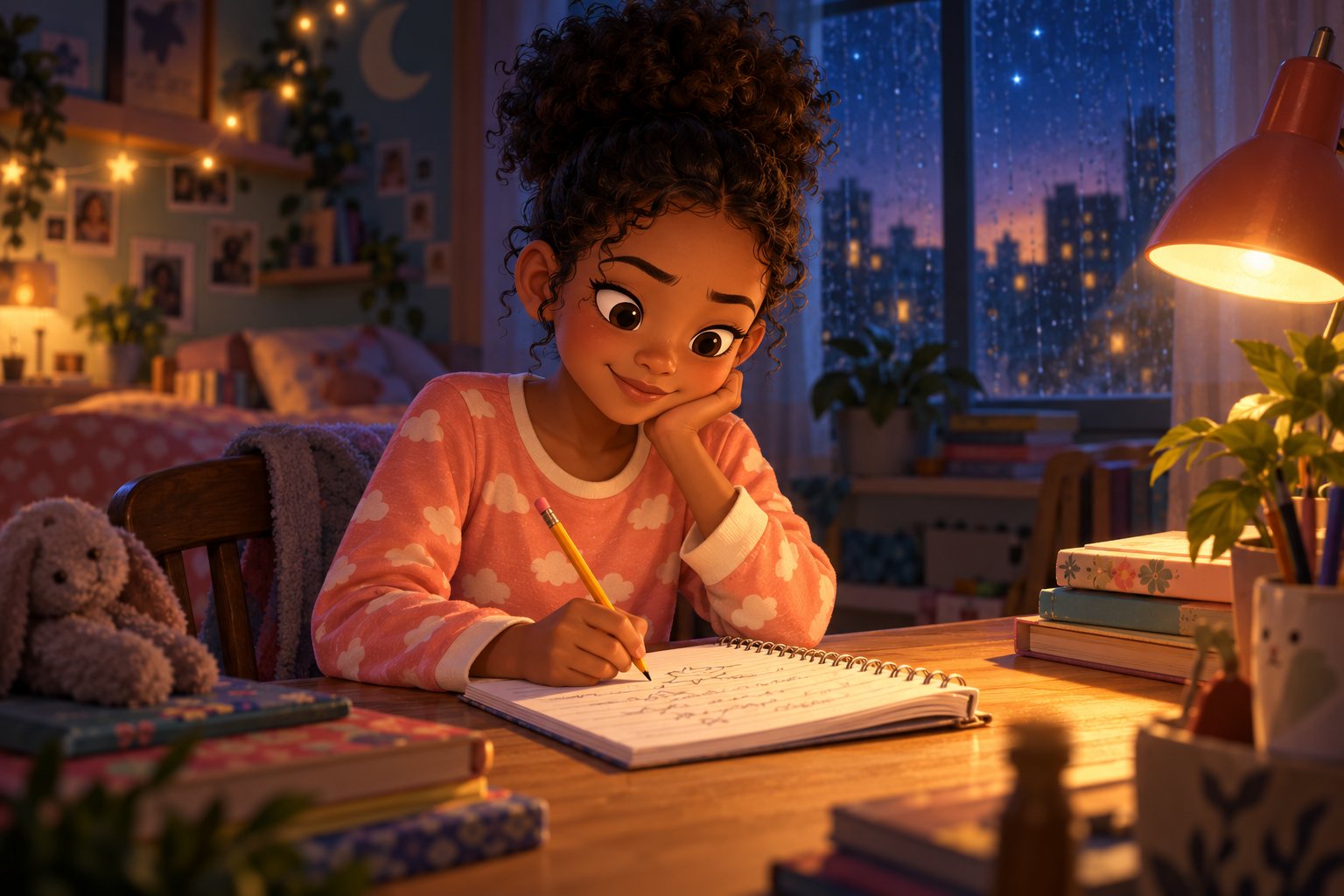
    Nia in cloud pyjamas writing in a notebook at her desk by lamplight, with a rainy night city outside the window.

    That night, Nia took a notebook from her desk and wrote on the first page, in her best handwriting:

    Things I don’t know about AI

    1. How does it hear me?
    2. Why did it think cool meant cold?
    3. Why did it change love you to love your GRAVY??
    4. Is it lonely?

    She looked at the list for a moment. Then she added one more.

    Your questions stay on this device. Keep this page and see how many you can answer by the end of the book.

    She had a feeling the answer was no. But she wanted to find out why.

    Before you go… can you answer these questions?

    No grades here. Just checking what you remember.

    Earn your Explorer Medal

    Type your first name to make your medal and get the first stamp in your Explorer’s Passport.


    So: welcome.

    You’re starting a small adventure. By the end of this book, you’ll know more about AI than most of the adults in your life. You’ll be able to use it more wisely. You’ll be able to think about it more clearly. And you’ll be better equipped to decide what you want it to do for the world you live in, instead of letting it simply happen to you.

    The day you first talked to a machine, you joined a story that humans have never lived before.

    Let’s figure out what that story is.

    An arched wooden door standing ajar, warm golden light and trees beyond it.

    Did you like Chapter One?